A commercial sandbag from a fitness equipment company runs $60 to $150 for a basic model, $200 or more for the premium ones with multiple handles and fillable bladders. They work well. They are also solving a problem that does not require $150 to solve.
Sand is heavy. Bags exist. The rest is details.
Here's how to build a functional training sandbag for under $15, what to avoid so it doesn't burst mid-workout, and six movements that make it the most versatile piece of equipment in a frugal home gym.
What a Sandbag Does That Nothing Else Does#
A barbell is predictable. The weight is fixed, the shape is fixed, and the load is distributed symmetrically. That predictability is a feature when you're trying to track precise loading.
A sandbag is unpredictable by nature. The fill shifts as you move. The load is asymmetric and constantly changing. This forces your stabilizing muscles (the muscles around your spine, hips, and shoulders that rarely get direct attention in standard training) to work continuously to control the bag.
This is sometimes called "odd object training." The research on it is modest but consistent: training with unpredictable loads transfers well to real-world physical tasks like carrying, lifting, and moving heavy things. A sandbag is also kind to your joints. It doesn't lock you into a fixed movement path the way a barbell does. You adjust to it, which reduces the risk of the acute joint stress that comes from rigid equipment.
For the cost, it's an argument that's hard to make against it.
How to Build One#
What you need:
- A heavy-duty contractor bag or large zip-lock bag (inner liner)
- A duffel bag or military-style kit bag (outer shell)
- Fill: play sand, pea gravel, or small river rocks
- Duct tape
Fill options and why it matters:
Play sand is the standard choice. It's dense, shifts moderately, and is available at any hardware store for $5 to $8 per 50-pound bag. The fine texture means it will find any weak point in your inner liner; seal it well.
Pea gravel is heavier by volume than sand and shifts more dramatically, which increases the instability training effect. It's also harder on the bag over time.
Rice works in a pinch for lighter bags (under 20 pounds) and doesn't stress the liner. It's not practical for heavy loads because you'd need enormous quantities.
Construction:
- Fill your inner liner, contractor bag or large zip-lock, to the desired weight. For most people starting out, 30 to 50 pounds is the right range. Leave some air space so the fill can shift.
- Squeeze out excess air and tape the liner shut. Use a lot of tape. A burst liner mid-workout is a mess you don't want.
- Place the sealed liner inside the duffel bag. A standard 30-inch duffel accommodates up to about 60 to 70 pounds comfortably.
- Close the duffel. You're done.
What to avoid:
Cheap garbage bags. The material is too thin for any lateral stress and will fail within a few sessions. Contractor bags (the thick black ones) are designed for weight and puncture resistance; use those.
Overfilling. The bag needs room for the fill to move. A completely full, rigid bag loses most of the sandbag training benefit and stresses the seams.
Anything with fine particles and no inner liner. Sand in your floor is a problem. Tape the liner.
Six Movements#
These six movements cover most of the same patterns as a full barbell program. You don't need anything else.
1. Sandbag Deadlift#
Stand with the bag between your feet. Hinge at the hips, grab the handles or wrap your arms around the bag, and stand up by driving through your heels. Lower with control.
The shifting load makes this more difficult to set up than a barbell deadlift. Your lats and core have to work harder to keep the bag stable as you pull.
Start: 3 × 8. Progress: Add weight; move to single-leg.
2. Sandbag Clean#
From the deadlift position, explosively extend your hips and pull the bag upward, rotating your elbows under it to catch it at shoulder height. Absorb with bent knees.
This is a power movement; you're training your ability to apply force quickly, not just your strength. The unpredictable load makes it considerably harder to time than a barbell clean.
Start: 3 × 5. Progress: Increase speed, not just weight.
3. Sandbag Shouldering#
Pick the bag up from the floor and drive it onto one shoulder. Lower it, pick it up, shoulder it to the other side. Alternate.
This is the most "real world" movement in the list. It's also the one that most exposes weaknesses in hip drive and grip; there's no handle to grab. You're wrestling it up.
Start: 3 × 5 each side. Progress: Increase weight; reduce rest time.
4. Sandbag Front Squat#
Hold the bag at chest height, bear-hug style. Squat to depth, keeping your elbows high. Stand up through your heels.
Holding weight in the front rack position forces your upper back to stay upright in a way that back squats don't. This is a feature, not a limitation; it develops the thoracic strength that most home gym trainees lack.
Start: 3 × 8. Progress: Heavier bag; paused squat at bottom.
5. Sandbag Row#
Hold the bag with both hands hanging in front of you. Hinge forward to roughly parallel with the floor, keep your back flat, and pull the bag toward your lower chest. Squeeze at the top.
Functionally equivalent to a barbell bent row. The shifting fill requires more grip and forearm work than a fixed implement.
Start: 3 × 8. Progress: Slower eccentric (3 seconds down); add weight.
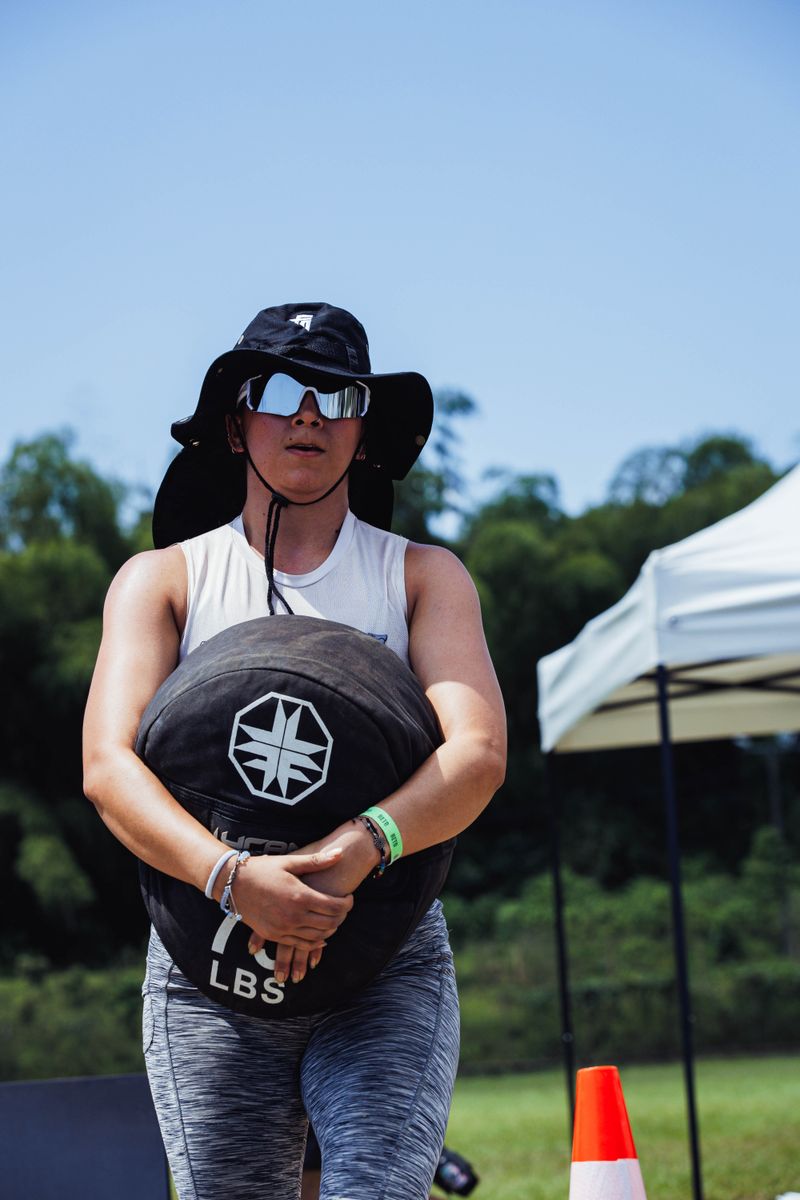
6. Sandbag Carry#
Pick it up any way that's comfortable (front rack, bear hug, over one shoulder) and walk. That's it.
Loaded carries are one of the most effective low-tech strength and conditioning tools available. They build total-body tension, grip strength, core stability, and cardiovascular capacity simultaneously. Walking 40 to 50 yards is a set. The carry builds strength and work capacity at the same time.
Start: 3 × 40-yard carries. Progress: Heavier load; one-shoulder alternating.
A Simple Training Session#
Warm up with 5 minutes of mobility or light movement. Then:
| Exercise | Sets | Reps |
|---|---|---|
| Sandbag deadlift | 3 | 8 |
| Sandbag front squat | 3 | 8 |
| Sandbag row | 3 | 8 |
| Sandbag shouldering | 3 | 5 each side |
| Sandbag carry | 3 | 40–50 yards |
Rest 90 seconds between sets. Total time: 30 to 35 minutes.
The Cost Argument#
A 50-pound bag of play sand costs $5 to $8. A heavy-duty duffel bag from a thrift store costs $3 to $10. A roll of contractor bags runs about $10 for 10. Total: under $20, often under $15.
A commercial sandbag with the same capacity costs $80 to $150, and it doesn't train you any better. The extra money buys sewn handles, a cleaner aesthetic, and the assurance that it won't leak. Valid quality-of-life improvements, but not fitness improvements.
Build the cheap version first. If you use it consistently for three months, you'll have earned the right to upgrade. Most people find they don't need to.
Do This Today#
Go to a hardware store and buy a 50-pound bag of play sand. You don't need to build the full sandbag today; just get the material. Having the sand in your space removes the friction from the next step.
The bag takes 10 minutes to assemble. The movements take one session to learn. The results take a few weeks to feel.