Most beginner fitness programs are written for people who are already somewhat fit. They assume you can do 10 push-ups, run for 20 minutes, or know what "superset" means. If that's not you, those plans feel defeating before you finish week one.
This plan starts from zero. No equipment, no gym, no prior fitness experience assumed. What it does require: showing up three days a week and doing the work as written, even when the early weeks feel easy. Especially then.
Before You Start: Two Things to Know#
Easy early on is the point. The first two weeks of this program will feel too easy for some people. That's intentional. Research from University College London found that habit formation takes an average of 66 days. The single most reliable way to shorten that timeline is to make the early behavior require less effort than expected. If you start too hard, you'll quit. If you start too easy, you'll finish.
You will be sore. Exercise causes microscopic damage to muscle fibers, which is how they grow back stronger. Delayed onset muscle soreness (DOMS) typically peaks 24 to 48 hours after a workout and is completely normal. If you're sore going into a workout day, do it anyway, but reduce the intensity by 20 to 30 percent. Soreness is not the same as injury pain. Injury pain is sharp, localized, and worsens during movement. Soreness is diffuse, achy, and usually improves once you warm up.
The Structure#
Three days a week, with at least one rest day between each session. A common schedule is Monday, Wednesday, and Friday. Tuesday, Thursday, Saturday also works. Pick what fits your life and keep it consistent.
Each session has three parts: a 5-minute warm-up, the main workout, and a 5-minute cooldown. Total time per session starts at about 20 minutes in week one and grows to about 35 minutes by week eight.
Weeks 1 and 2: Build the Habit#
The goal of the first two weeks is not fitness. It's showing up. Every session you complete in this phase is teaching your brain and your schedule that this is something you do now.
Warm-up (do this before every session): 30 seconds each: marching in place, arm circles forward, arm circles backward, hip circles, bodyweight squats with no depth requirement, shoulder rolls. Repeat once. Total: about 5 minutes.
Main workout:
- Wall push-ups: 2 sets of 10. Stand arms-length from a wall, place your hands on it at chest height, and lower your chest toward the wall, then press back. This is a real push-up. It just removes most of the bodyweight load so you can learn the movement pattern.
- Bodyweight squats: 2 sets of 10. Feet shoulder-width apart, toes slightly out. Sit back and down until your thighs are parallel (or as deep as comfortable). Drive through your heels to stand.
- Seated leg raises: 2 sets of 10. Sit on the edge of a sturdy chair. Straighten one leg and hold for 2 seconds, then lower. Alternate legs. Works the hip flexors and quads.
- Plank hold: 2 sets of 15 seconds. Forearms and toes on the floor, body in a straight line from head to heels. Core tight, don't let your hips sag or pike.
Rest 60 seconds between sets.
Cooldown: 30 seconds each: standing quad stretch (hold ankle behind you), standing calf stretch (step back, press heel down), seated hamstring stretch (legs straight, reach for toes), chest opener (hands clasped behind back, squeeze shoulder blades). Total: about 5 minutes.
Weeks 3 and 4: Add Load#
You've shown up six times. That's the hard part done. Now you increase the challenge slightly.
Main workout:
- Incline push-ups: 2 sets of 12. Same as wall push-ups, but use a counter or the back of a couch instead. Lower angle means more bodyweight load.
- Bodyweight squats: 3 sets of 12.
- Step-ups: 2 sets of 10 per leg. Use the bottom stair, a sturdy box, or a low ottoman. Step up with one foot, bring the other foot up, then step back down. This builds single-leg strength and balance.
- Plank hold: 2 sets of 25 seconds.
- Superman hold: 2 sets of 10. Lie on your stomach, arms extended overhead. Lift your arms, chest, and legs off the floor at the same time. Hold 2 seconds. Lower. This strengthens the lower back and posterior chain.
Rest 60 seconds between sets.
Weeks 5 and 6: First Real Push-Ups#
This is where it starts feeling like actual exercise.
Main workout:
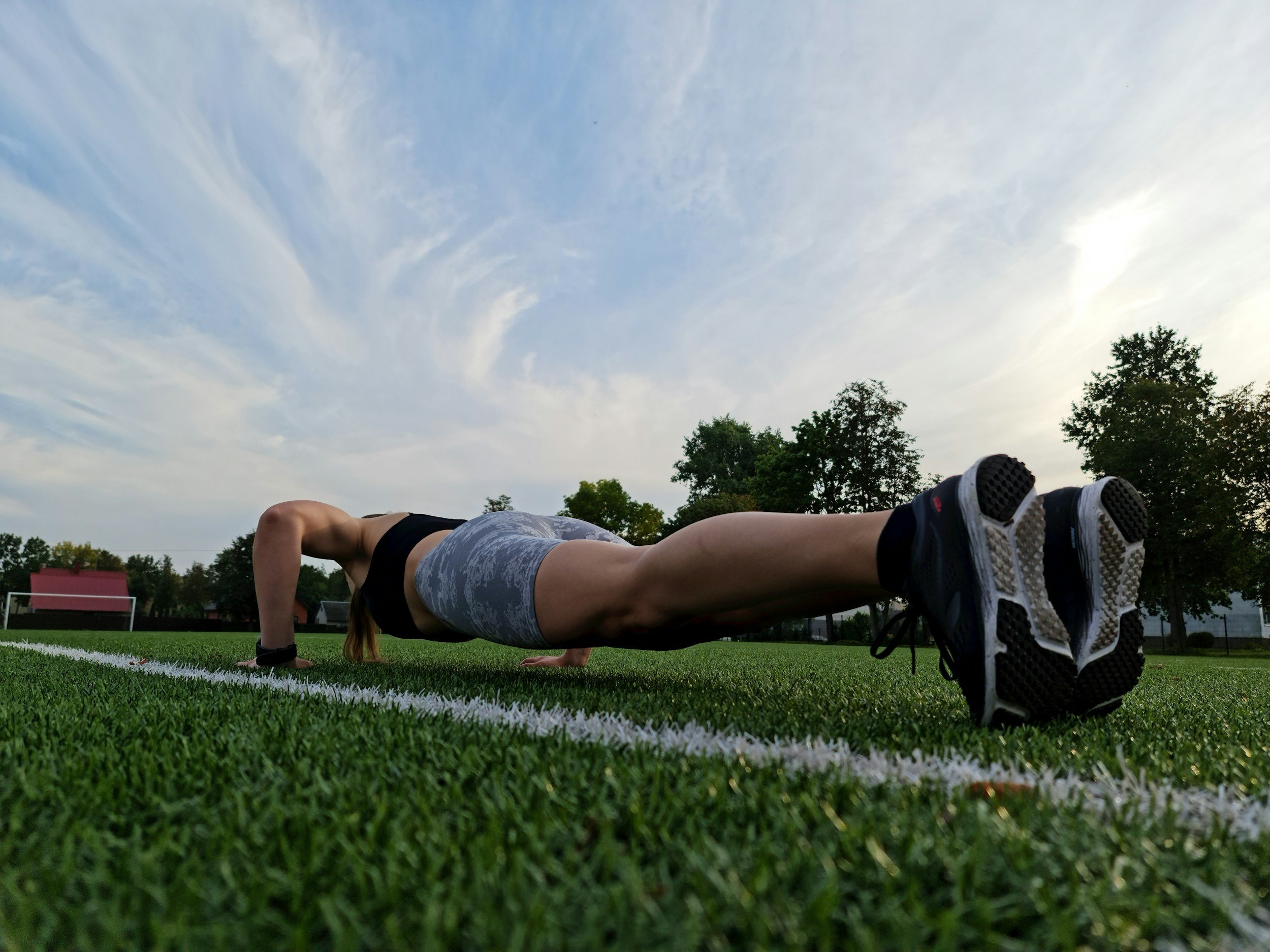
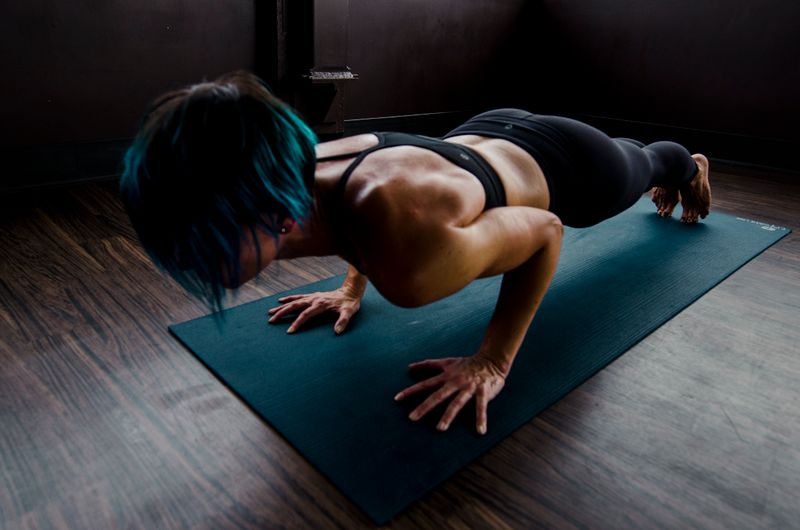
- Knee push-ups: 2 sets of 8, then push-ups from your toes: 1 set of as many as you can do with good form. If you can only do 2, do 2 and count it. The goal is getting the pattern right. Chest to the floor, elbows at 45 degrees, full extension at the top.
- Bodyweight squats: 3 sets of 15. Or, if squats feel easy, try a slow squat: 3 seconds down, 1 second pause at the bottom, drive back up. Same movement, much harder.
- Step-ups: 3 sets of 10 per leg.
- Reverse lunges: 2 sets of 8 per leg. Stand tall, step one foot back, lower your back knee toward the floor, then push back up to standing. Reverse lunges are easier on the knee than forward lunges for most beginners.
- Plank hold: 2 sets of 35 seconds.
Rest 60 seconds between sets.
Weeks 7 and 8: The Full Program#
By now you've been training for six weeks. Your body has adapted significantly from where it started, even if it doesn't feel dramatic. Your resting heart rate has likely dropped, your balance has improved, and the movements that felt awkward in week one are now automatic.
Main workout:
- Push-ups from your toes: 3 sets, as many as you can do with good form. Stop each set 1 to 2 reps before your form breaks down. Record your numbers each session.
- Squats: 3 sets of 15, with the slow tempo (3 seconds down, 1 second pause).
- Reverse lunges: 3 sets of 10 per leg.
- Glute bridges: 3 sets of 15. Lie on your back, knees bent, feet flat on the floor. Drive your hips up until your body forms a straight line from knees to shoulders. Squeeze your glutes at the top. Lower and repeat. This is one of the most effective posterior chain exercises available without equipment.
- Plank hold: 3 sets of 45 seconds.
- Dead bug: 2 sets of 8 per side. Lie on your back, arms pointing toward the ceiling, knees bent at 90 degrees (shins parallel to the floor). Slowly lower your right arm and left leg toward the floor simultaneously while keeping your lower back pressed against the floor. Return and repeat on the other side. This teaches core stability in a way that transfers to everything else you do.
Rest 60 seconds between sets.
What Comes After Week 8#
After eight weeks, you'll have a real baseline. From here, you have several directions:
Add resistance. A $12 loop band set and a $25 to $30 tube band set opens up a full resistance training program. The Full-Body Resistance Band Workout is a direct next step from this program.
Increase volume. Add a fourth training day, or add one more set to each exercise in the week 8 program.
Add cardio. Start with 15 to 20 minutes of walking or jogging 2 days a week. Work up to 30 minutes. The No-Equipment Cardio article covers what's actually effective at the beginner level.
Keep the program. If life got in the way and you didn't hit all 24 sessions perfectly, run week 7 and 8 again before progressing. Eight weeks of imperfect training beats two weeks of perfect training every time.
Tracking Your Progress#
You don't need an app. A piece of paper works. After each session, write down what you did: the date, the exercise, the number of sets and reps, and how it felt. This gives you data to look back on, which is motivating, and it helps you see when an exercise is getting easy and it's time to progress.
The How to Track Progress Without a Fancy App or Wearable guide covers the minimal tracking system that works long-term.
The Bottom Line#
Eight weeks of three-sessions-a-week bodyweight training, starting from beginner-level work and progressing consistently, will meaningfully change your strength, endurance, and how your body feels. None of this requires spending money, joining anything, or knowing anything about fitness going in.
The only requirement is showing up on the days you said you would.
Do this today: Write down three days this week you'll do a session. Not "I'll work out this week." Three specific days with a specific time. Put them in your calendar. Do the week 1 and 2 workout on the first of those days. The whole thing takes about 20 minutes.