Resistance bands are legitimately good training tools. Research published in the Journal of Human Kinetics found that band-based resistance training produces muscle strength gains comparable to free weights, especially for people newer to training. The problem is that most people buy a set, do a few awkward exercises, and let them sit in a drawer.
This workout fixes that. You get a complete program that covers your upper body, lower body, and core. It takes under 30 minutes and needs only one set of tube bands and a door anchor. If you don't have bands yet, a tube band set with handles and a door anchor runs about $25 to $30 on Amazon. That's the only equipment this workout needs.
What You Need#
A tube band set with handles (the kind that comes with a door anchor). A set of five loop bands works for the lower body exercises. You don't need both to start. A $25 to $30 tube band set covers the whole workout.
If you want specifics on what to buy, the Best Resistance Bands for Home Workouts breakdown covers every option worth considering at this price range.
How to Structure the Workout#
Three rounds. Eight exercises. Rest 45 to 60 seconds between exercises, and 90 seconds between rounds. Total time including warm-up: 25 to 30 minutes.
Do 12 to 15 reps of each exercise unless otherwise noted. If you're finishing a set and have gas left in the tank, move to a heavier band or shorten your rest. If you're struggling to finish with good form, use a lighter band or take the full rest.
The Warm-Up (3 to 5 Minutes)#
Don't skip this. Cold muscles and bands are a bad combination.
Do 30 seconds each of: arm circles (forward and backward), hip circles, bodyweight squats, and jumping jacks or marching in place. That's it. Two minutes of light movement is enough to get blood moving and joints ready.
The Workout#
1. Banded Squat (Lower body)
Stand on the middle of the band with feet shoulder-width apart. Hold one handle in each hand at shoulder height, elbows pointed forward. Squat until your thighs are parallel to the floor, keeping your chest up and your knees tracking over your toes. Drive through your heels to stand. The band adds resistance at the top of the movement, where a squat is typically easiest, which evens out the difficulty across the whole range of motion.
12 to 15 reps.
2. Banded Row (Upper back, biceps)
Anchor the band at chest height in a door. Face the door, hold both handles, and step back until there's good tension with your arms extended. Pull your elbows straight back, squeezing your shoulder blades together at the end of the movement. Pause for one second before releasing. Keep your core tight and don't let your lower back arch.
12 to 15 reps.
3. Banded Chest Press (Chest, triceps, front shoulder)
Anchor the band behind you at shoulder height. Face away from the door, hold both handles at chest level with elbows out to the sides. Press forward until your arms are fully extended. Control the return. Don't let the band yank your arms back. This mimics a cable chest press and hits the pec fibers effectively when done with full range of motion.
12 to 15 reps.
4. Banded Romanian Deadlift (Hamstrings, glutes)
Stand on the band with both feet hip-width apart, one handle in each hand hanging in front of your thighs. Keep a slight bend in your knees. Hinge at the hips, pushing them back as you lower the handles toward mid-shin, maintaining a flat back throughout. Drive your hips forward to return to standing. You should feel this in your hamstrings and glutes, not your lower back. If your lower back is doing all the work, your hips aren't hinging enough.
12 reps.
5. Banded Overhead Press (Shoulders, triceps)
Stand on the band with feet shoulder-width apart. Hold the handles at shoulder height with palms facing forward. Press straight up until your arms are extended overhead. Lower with control. Keep your core tight and don't lean back as you press.
12 reps.
6. Banded Lateral Walk (Outer glutes, hip abductors)
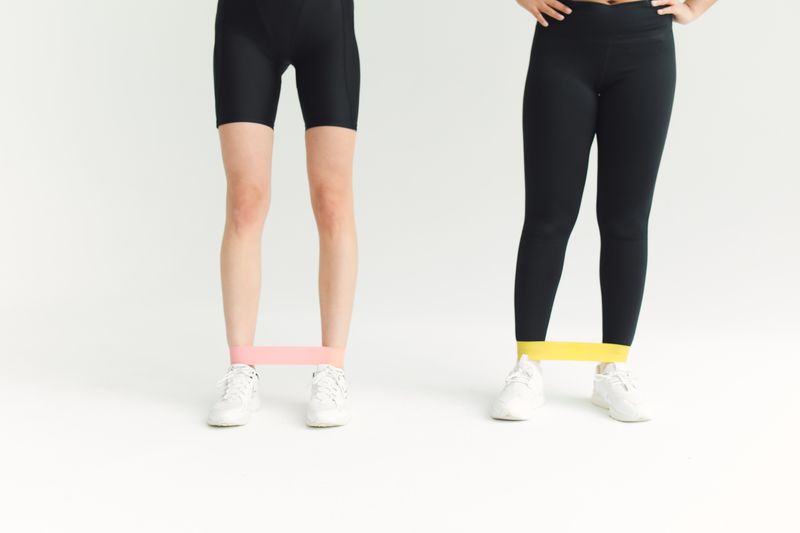
For this one, use a loop band placed just above your knees. Stand with feet hip-width apart and a slight bend in your knees. Step sideways to the right for 10 steps, then 10 steps back to the left. Keep tension on the band the whole time. Don't let your feet come together. This exercise targets the gluteus medius, which most people never train and which is critical for knee stability and hip function.
10 steps each direction = 1 set.
7. Banded Bicep Curl (Biceps)
Stand on the band with feet hip-width apart, one handle in each hand with palms facing up. Curl both handles toward your shoulders, keeping your elbows pinned to your sides. Lower slowly. A 3-second descent builds more muscle than a quick drop. The band adds progressive resistance as you curl, which matches the strength curve of the bicep well.
15 reps.
8. Banded Pallof Press (Core, anti-rotation)
Anchor the band at chest height. Stand sideways to the door, about two feet away. Hold both handles at your chest with both hands. Press straight out in front of you, hold for two seconds, then bring them back. The band pulls you toward the anchor point. Your core's job is to resist that rotation. This is one of the most effective core exercises you can do with a band, and most people have never heard of it.
10 reps each side.
Progressive Overload: How to Keep Getting Stronger#
The workout above gets you started. To keep seeing results past the first few weeks, you need to keep challenging your muscles. With bands, you have three options.
Move up a resistance level when 15 reps start feeling easy. Most tube band sets include multiple bands you can stack for more resistance. Stacking two medium bands gives you more tension than one heavy band.
Slow down the lowering phase. A 3 to 4 second eccentric (the part where you're resisting the band on the way back) dramatically increases muscle stress without requiring heavier resistance. Research from the Journal of Strength and Conditioning Research consistently shows eccentric-focused training drives significant strength and size gains.
Reduce rest time. As your conditioning improves, cutting rest from 60 seconds to 45 seconds increases the training density without adding any time to your workout.
How Often to Do This#
Three times a week, with at least one rest day between sessions. That's enough frequency to see consistent strength gains without overtraining. A typical schedule: Monday, Wednesday, Friday. Or Tuesday, Thursday, Saturday. Whatever fits your week.
Research from the American College of Sports Medicine supports two to three strength sessions per week as optimal for beginners and intermediate trainees building a base.
The Bottom Line#
Thirty minutes, one band set, and consistent effort three days a week is enough to build real strength. This isn't a scaled-down version of a "real" workout. It's a program that produces results because it follows the same principles any effective resistance training program does: multi-joint movements, progressive overload, and enough volume to force adaptation.
Do this today: Run through the warm-up and the first three exercises right now to learn the movement patterns before you try the full workout. Getting the form right on the row, chest press, and squat takes about 10 minutes and makes the full session much more effective.