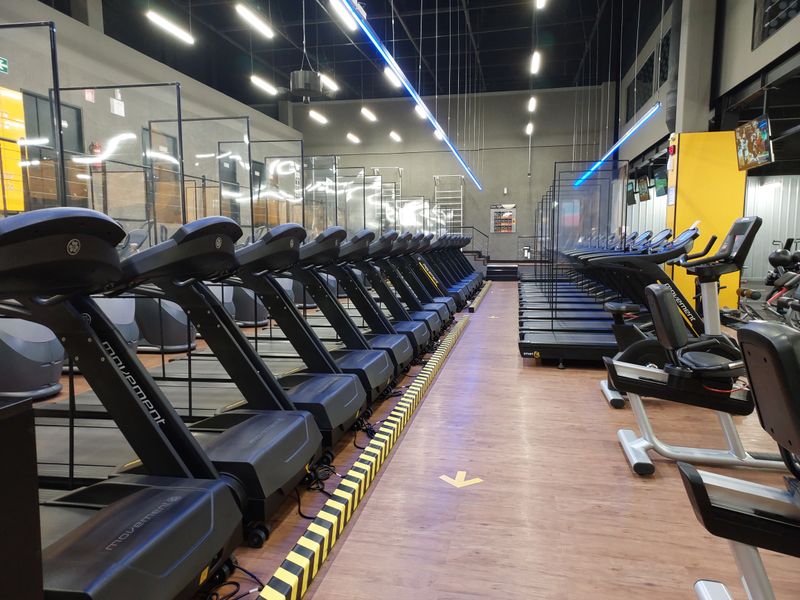
The gym versus home gym question comes up constantly, and it almost always gets answered with "it depends" — which is accurate but not useful. Here's a more useful version: it depends specifically on how often you go, what you actually do when you're there, and how you value your time. Those three variables make the math clear.
The Truth About a Gym Membership#
The monthly fee is the visible cost. It's not the only one.
A standard commercial gym runs $30–80 per month (Planet Fitness at the low end, mid-tier chains like LA Fitness or YMCA in the middle). Boutique studios — CrossFit, Orange Theory, spin — run $100–250 per month. At the standard tier, annual cost ranges from $360 to $960.
That's before the hidden costs. If your gym is 15 minutes away and you go three days a week, you're spending roughly 72 hours per year commuting. At any reasonable valuation of your time, that's significant. Add initiation fees ($50–100, sometimes waived), potential cancellation fees if you want to leave before a contract ends, and the incidental spending that happens near gyms — the protein bar at the front desk, the parking, the coffee on the way home.
A $50/month gym membership with a 20-minute round-trip commute costs approximately $600 in money and 78 hours per year. That's the real price.
What it gets right:
- Access to equipment you can't afford or fit at home — heavy machines, barbells, cables, pools, turf
- Social environment that drives consistency for people who train better around others
- Variety and novelty that keeps training from going stale
- Classes and coaching that add structure for people who struggle to program themselves
Where it falls short:
- Monthly cost never stops — 10 years of a $50/month membership is $6,000
- Commute time is a hidden tax that compounds across years
- Contracts, cancellation fees, and rate increases are common
- You're paying whether you go or not, which creates a sunk cost that doesn't actually make you go
The Truth About a Home Gym#
The setup cost is visible. The space cost and the motivation question are less obvious.
Three tiers cover almost every type of exerciser:
Tier 1 — Bodyweight only ($0–80): A yoga mat, door-mounted pull-up bar, and a resistance band set. This covers push, pull, squat, hinge, and core — the complete movement vocabulary. The limitation is loading: bodyweight training requires creative progressions past the beginner stage.
Tier 2 — Dumbbells and basics ($150–400): Add adjustable dumbbells or a few fixed pairs. This solves the loading problem for most people. A dumbbell pair and band set handles the majority of strength training needs and costs a fraction of a year's gym membership.
Tier 3 — Barbell and rack ($500–1,200): Matches or exceeds most commercial gyms for strength training. Equipment lasts decades. Front-loaded cost, zero ongoing cost.
The hidden costs work differently than a gym. Space is real — in a small apartment, 60 square feet of equipment is a genuine trade-off. Used equipment holds value reasonably well; a dumbbell set bought for $200 can sell for $120–150. And the motivation question is honest: some people train better with the social pressure of a gym. For them, the home gym is cheaper financially and less effective in practice.
What it gets right:
- Zero ongoing cost after the initial investment — 10 years of training with a Tier 2 setup costs $250 total
- No commute, no hours, no waiting for equipment
- Equipment you own outright doesn't require a subscription or contract
- Over time, the financial gap between home and gym widens significantly
Where it falls short:
- Upfront cost is higher than a first month's gym fee
- Space requirements are real, especially for Tier 2 and 3 setups
- No built-in community or social accountability
- Some training types (heavy machines, pool, turf, specific equipment) genuinely can't be replicated at home
Where It Lands#
Pull up your bank statement and calculate your actual cost-per-visit over the last 12 months. That number tells you most of what you need to know.
Above $10 per visit: A home gym almost certainly wins financially, even at Tier 2 prices. You're paying for equipment you're not fully using.
Below $10 per visit, going 3+ times a week consistently: The gym is working for you. Factor in whether the social environment or specific equipment is driving that consistency — if it is, the membership cost is doing real work.
The honest middle: A minimal home setup ($60–80 for a mat, bands, and pull-up bar) as a supplement to a gym membership is often the best of both. You train at home when you can't make it in, and the gym covers what home can't.
Five-year math for a consistent user:
- Gym at $50/month: $3,000
- Tier 2 home gym: $250
That $2,750 difference is the real coin toss.