Most people who train without equipment plateau within a few months. Not because bodyweight training stops working, but because they stop applying the one principle that makes any training work: progressive overload.
Once you understand it, you can keep making progress indefinitely, with no gym membership, no equipment, and no additional cost.
What Progressive Overload Actually Is#
Progressive overload means doing slightly more than last time. That's the whole concept.
Your muscles adapt to stress. When you do something hard enough to challenge them, they come back slightly stronger to handle that demand next time. The moment the workout stops being a challenge, the adaptation stops. To keep getting stronger, you have to keep increasing the challenge.
In a gym, this is straightforward: add 5 pounds to the bar. Without weights, the same principle applies, but you vary the form of the increase instead of the load.
Research consistently supports this. A 2019 review in the Journal of Strength and Conditioning Research analyzing 22 studies found that progressive loading, regardless of the specific exercise modality, was the most reliable predictor of strength gains over time. The mechanism works the same whether you're lifting barbells or doing bodyweight variations.
Six Ways to Apply Progressive Overload Without Equipment#
1. Add Reps#
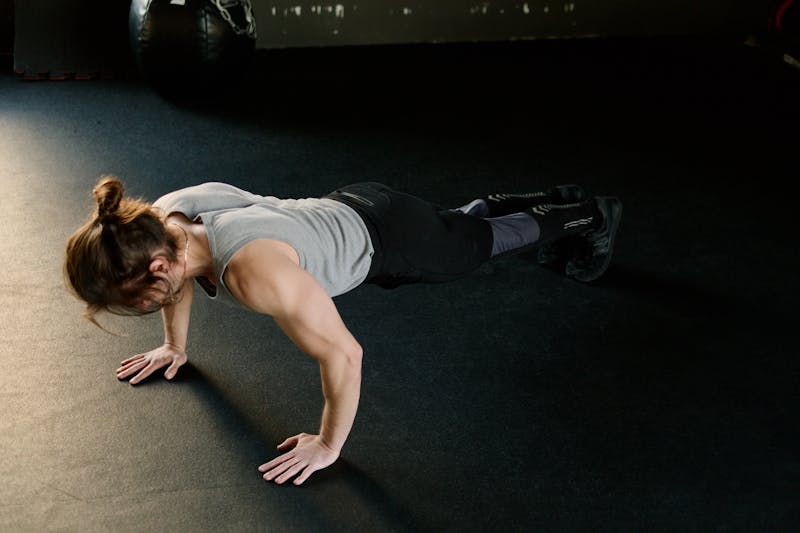
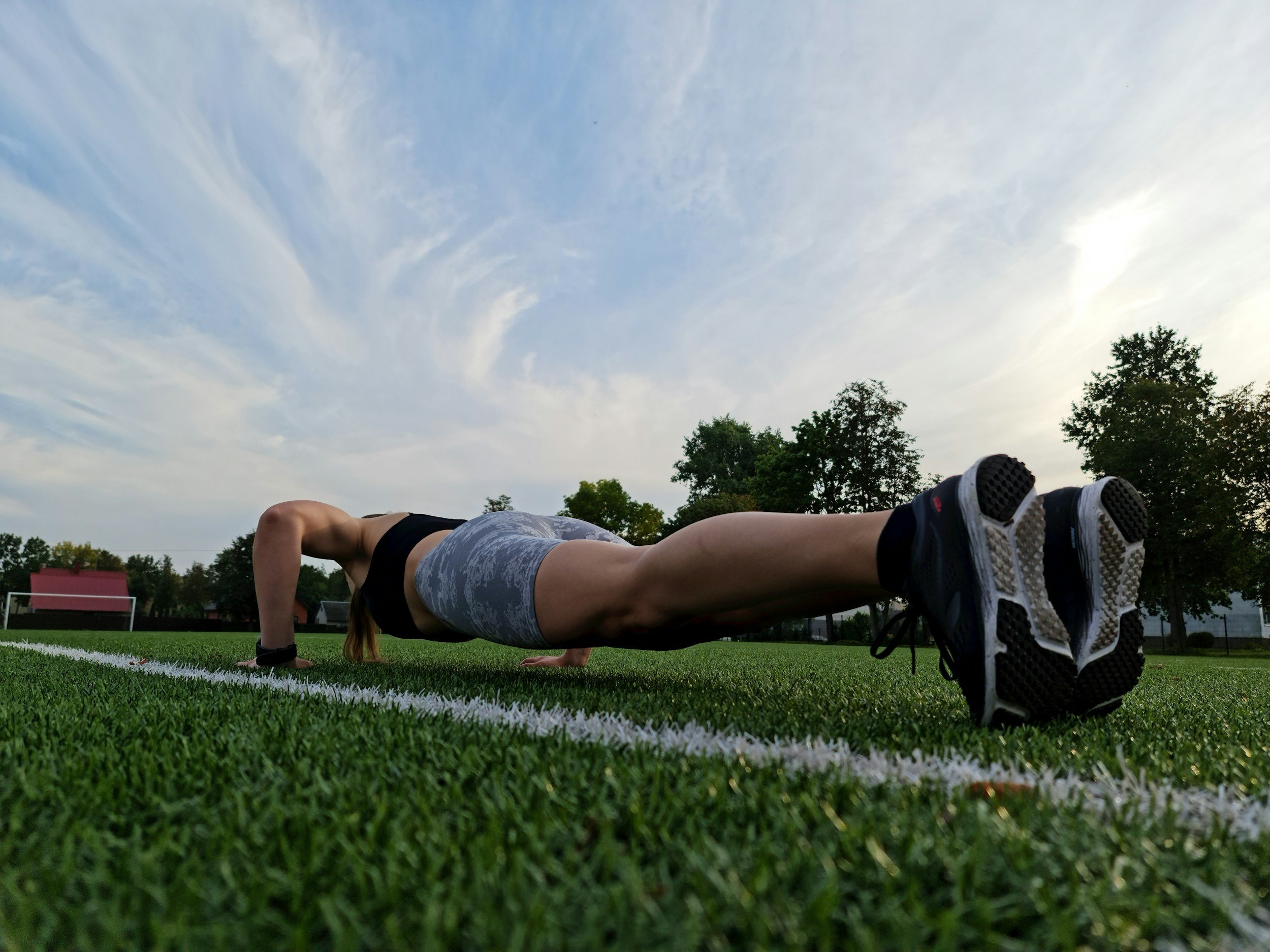
The most obvious approach. If you did 3 sets of 8 push-ups last session, aim for 3 sets of 9 this session. When you reach 3 sets of 12, move to a harder variation rather than continuing to add reps indefinitely. Extremely high rep ranges (30+) shift the training effect toward muscular endurance rather than strength.
2. Add Sets#
Going from 2 sets to 3 sets, or 3 to 4, increases total volume. Research on hypertrophy, summarized in Schoenfeld's 2017 meta-analysis in the Journal of Strength and Conditioning Research, found that higher volume training (more total sets per week) produces greater muscle growth up to a recoverable limit. More sets is a legitimate form of progression.
3. Use Harder Variations#
This is the most powerful tool in bodyweight training and the one most people underuse. There is almost always a harder version of any exercise:
Push progressions: Incline push-up, push-up, close-grip push-up, slow-eccentric push-up (3-second lowering), push-up with feet elevated, pike push-up, archer push-up
Pull progressions: Table row, doorframe row, horizontal bar row, assisted pull-up, pull-up, weighted pull-up
Squat progressions: Chair-assisted squat, bodyweight squat, paused squat, single-leg box squat, pistol squat progression
Hinge progressions: Hip hinge with wall, single-leg deadlift pattern, Romanian deadlift with backpack weight
When the current variation becomes manageable, move up one step. This is progressive overload applied to exercise selection rather than load.
4. Reduce Rest Time#
Completing the same workout with less rest between sets is harder and constitutes a form of progress. If you rested 90 seconds between sets last week and you rest 75 seconds this week while hitting the same reps, that's a meaningful increase in training density.
This isn't a first choice for strength development, but it's a useful second tool when you've maxed out reps on a variation and aren't quite ready to move up.
5. Slow the Movement Down#
A push-up with a 3-second lowering phase and a 1-second pause at the bottom is significantly harder than a standard-pace push-up. Tempo manipulation increases time under tension, which is one of the mechanisms behind muscle growth. A 3010 tempo (3 seconds down, 0 pause at bottom, 1 second up, 0 pause at top) or 3011 (with a 1-second pause) can make a variation you've mastered challenging again.
6. Increase Range of Motion#
Full-range squats are harder than partial squats. Push-ups done on two elevated objects so your chest can travel below your hands (deficit push-ups) are harder than standard push-ups. Using the full range of motion, or increasing it deliberately, adds demand without changing any other variable.
How to Structure Progression in Practice#
The most common mistake is progressing inconsistently, sometimes adding reps, sometimes not, with no system. This makes it impossible to know whether you're actually advancing.
A simple system:
- Pick a rep range target, say 3 sets of 8 to 12.
- Start a variation at the bottom of the range (3 sets of 8).
- Add 1 to 2 reps per session until you reach the top of the range (3 sets of 12).
- Move to the next harder variation at the bottom rep count (3 sets of 8 again).
- Repeat.
This is the structure used in the 3-day strength plan and 2-day strength program on this site. The progressions are explicit rather than left to guesswork.
The Most Important Variable: Effort#
Progression only works when the training is hard enough to require adaptation. Specifically, research suggests sets should be taken within 2 to 3 reps of failure to stimulate meaningful adaptation. If you finish a set of 10 push-ups and feel like you could do 20 more without any difficulty, the training stimulus is too low to drive progress.
This doesn't mean training to failure every set. Frequent failure raises injury risk and makes recovery harder. But sets that end comfortably, with large reserves left, aren't producing much adaptation.
The practical test: if you finish your last set and aren't somewhat relieved it's over, the variation isn't hard enough.
What Breaks Progress#
Changing the workout too often#
Frequent program-switching prevents you from measuring progress. You can't tell whether you're getting stronger if you keep changing what you're doing. Stay with the same movements for at least 6 to 8 weeks.
Staying at the same variation forever#
The opposite problem. Doing the same push-up variation for six months stops producing results after the first few. You need a system that moves you to harder variations when the current ones stop being challenging.
Ignoring recovery#
Progressive overload only works if the body has time to adapt between sessions. Insufficient sleep (under 7 hours), inadequate protein, or training the same muscle groups every day without rest will stall progress regardless of how well-structured the programming is. Research on protein synthesis timelines suggests most people need 48 to 72 hours between sessions targeting the same muscle groups.
The Honest Timeline#
For a beginner applying these principles consistently:
Weeks 1 to 4: Neurological adaptation is the primary driver. You'll add reps quickly. This isn't muscle yet; it's your nervous system learning to fire muscles more efficiently.
Weeks 4 to 12: Actual strength and muscle development begins. Progress slows but becomes more durable.
Month 3 onward: Progression becomes slower but remains real. This is where most people plateau because they haven't systematically advanced their variations.
With a structured approach to progressive overload, bodyweight training can take someone from beginner to meaningfully strong over 6 to 12 months, with zero equipment and zero cost beyond the time invested.
Do this today: Write down what you did in your last workout. Every set, every rep, every exercise. That's your baseline. Next session, beat it in at least one way.