Cardio doesn't require a machine. It requires elevating your heart rate and sustaining it for long enough to produce a training effect. Everything else is optional.
The treadmill and stationary bike industries have done an effective job convincing people otherwise. But the research on cardiovascular fitness doesn't show that expensive equipment produces better outcomes than structured bodyweight training. It shows that sustained effort at a sufficient intensity is what matters.
Here's what that looks like with no equipment and no cost.
What Counts as Cardio#
For practical purposes, cardio is any activity that keeps your heart rate elevated in a target zone for an extended period. The American College of Sports Medicine defines moderate-intensity cardio as 50 to 70 percent of maximum heart rate, and vigorous-intensity as 70 to 85 percent.
For most adults, moderate intensity feels like you could hold a conversation but wouldn't want to sing. Vigorous intensity is when talking requires effort and you're glad when the interval ends.
Both intensities produce cardiovascular benefits. Vigorous intensity produces them faster, which is why high-intensity work is popular for short sessions.
The No-Equipment Options That Work#
Jumping Jacks#
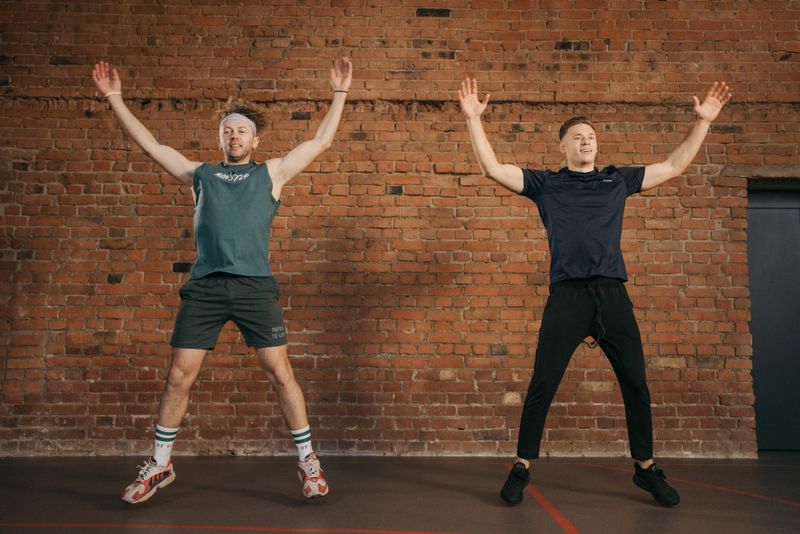
The simplest full-body cardio movement. At a moderate pace, jumping jacks elevate heart rate quickly and can be sustained for several minutes. At a vigorous pace, they become a genuine cardio challenge. They also require almost no skill, which makes them good for warm-ups and beginners.
For variety: cross jacks (arms cross at chest level instead of overhead), squat jacks (squat on the way down), or plank jacks (in a push-up position, jump feet wide and back).
High Knees#
Running in place with an emphasis on driving the knees up toward the chest. Done at a fast tempo for 30 to 60 seconds, high knees elevate heart rate quickly. The hip flexors and core work harder than they do in standard running because of the knee height requirement.
The useful variation: instead of continuous high knees, use a sprint-and-pause pattern: 20 seconds of fast high knees, 10 seconds of recovery walk in place, repeat.
Mountain Climbers#
A plank with alternating knee drives toward the chest, performed at speed. Mountain climbers combine core stability with cardiovascular demand. Done at a brisk pace for 30 to 45 seconds, they're a legitimate high-intensity interval option. Done slowly, they're a core exercise.
Burpees#
The most-dreaded movement in fitness for a reason. A burpee is a squat thrust from standing, a push-up at the bottom, and a jump at the top. Done continuously, they're one of the most calorie-demanding bodyweight movements per minute.
A 2015 study in the Journal of Strength and Conditioning Research found burpees produced similar metabolic responses to sprint intervals. If you hate them, they're working.
Modified burpee for beginners: drop the push-up at the bottom and the jump at the top. Step down and step back up instead of jumping. This reduces intensity while maintaining the full movement pattern.
Squat Jumps#
A squat with an explosive jump at the top. Squat jumps combine lower body strength with cardiovascular demand and produce a training effect that's hard to replicate with continuous movement alone. Thirty seconds of squat jumps followed by 30 seconds of regular squats is a simple but effective interval structure.
Note: squat jumps are high-impact. If you have knee pain or joint issues, skip these and use squat-to-stand or step-ups instead.
Stair Climbing#
If you have stairs, you have cardio equipment. Stair climbing is lower-impact than running, uses the posterior chain (glutes and hamstrings) more than typical walking, and elevates heart rate quickly. Ten minutes of steady stair climbing is a real workout for someone in normal health.
For higher intensity: run up the stairs and walk down. For higher volume: do multiple continuous trips rather than single-floor climbs.
Shadow Boxing#
Three minutes of continuous shadow boxing, which involves shuffling footwork, upper body punches, and defensive movements, maintains heart rate in a cardio range while also engaging coordination and mental focus. It's also more interesting than jumping jacks.
You don't need to know boxing technique to get the cardiovascular benefit. Just keep moving continuously for the round.
How to Structure a No-Equipment Cardio Session#
Option 1: Steady-State (20 to 30 Minutes)#
Pick one movement, say jumping jacks, and maintain a moderate pace for the duration. Add variety by switching between 3 to 4 movements every 5 minutes. This is the equivalent of a 20-minute jog, just without the running.
This structure is good for people building a base or on recovery days between harder training sessions.
Option 2: HIIT Circuit (15 to 20 Minutes)#
Work for 30 to 45 seconds, rest for 15 to 30 seconds, repeat with 4 to 6 movements:
- Jumping jacks: 40 seconds / rest 20 seconds
- Mountain climbers: 40 seconds / rest 20 seconds
- High knees: 40 seconds / rest 20 seconds
- Burpees: 40 seconds / rest 20 seconds
- Squat jumps: 40 seconds / rest 20 seconds
- Shadow boxing: 40 seconds / rest 20 seconds
Rest 90 seconds, then repeat 2 to 3 times. Total time: 18 to 25 minutes.
Research on HIIT published in the Journal of Physiology found that 10 minutes of high-intensity intervals produced similar cardiovascular adaptations to 45 minutes of moderate-intensity continuous work. The tradeoff is that HIIT is harder to sustain for beginners and requires more recovery between sessions.
Option 3: EMOM (Every Minute on the Minute)#
Set a timer. Every minute, perform a set number of reps of one exercise. Rest for the remainder of the minute. Change the exercise each minute.
Example 10-minute EMOM:
- Minute 1: 15 jumping jacks
- Minute 2: 10 burpees
- Minute 3: 20 high knees (each leg)
- Minute 4: 12 squat jumps
- Minute 5: 30 seconds mountain climbers
- Repeat minutes 1 to 5
This structure is time-efficient and self-regulating: as you get fitter, completing the work takes less of the minute, giving you more rest. As you get stronger, you increase the rep count.
The $10 Upgrade Worth Considering#
A jump rope adds a significant tool to no-equipment cardio. Research in the Research Quarterly for Exercise and Sport found that 10 minutes of jumping rope produces cardiovascular benefits comparable to 30 minutes of jogging. It also improves coordination and rhythm in ways that stationary movements don't.
The barrier: it requires ceiling clearance (12 inches above your head) and a flat surface. If you have both, a basic speed rope runs around $10 and dramatically expands what you can do for cardio.
The jump rope and pull-up bar review covers specific options at various price points.
When No-Equipment Cardio Is Enough#
For general cardiovascular health, 150 minutes of moderate-intensity activity per week is the standard public health recommendation from the World Health Organization. No-equipment bodyweight cardio easily meets this standard.
For fat loss, the variables that matter most are overall calorie balance and consistency. No-equipment cardio burns real calories and supports fat loss when combined with a reasonable diet.
For performance goals, such as improving a 5k time or preparing for a sport, sport-specific training eventually matters. But for general fitness and health, consistent bodyweight cardio is a complete solution.
Do this today: Set a 15-minute timer and work through the HIIT circuit above. That's the whole barrier to entry. If you can finish all 3 rounds, you have a solid cardio baseline.