Small apartment living creates real training constraints. A studio or one-bedroom with shared walls, a floor that transmits sound to downstairs neighbors, and a living room that doubles as a bedroom does not easily accommodate burpees at 7 AM.
This is a solvable problem. The constraints change which exercises you choose, not whether you can train effectively.
The Space Math#
A 6-foot by 6-foot area is enough for a complete training session. That is the footprint of a yoga mat plus a few feet of clearance on each side. Most apartment living spaces can clear that much floor, even if it requires moving a coffee table.
The exercises that need more space than this are mostly running-based movements: shuttle runs, broad jumps, and anything that requires traveling laterally across a room. All of these have functional substitutes that fit in a small footprint.
If you do not own a mat, puzzle floor tiles ($20 to $30 for a set) protect your floors and joints and stack neatly in a corner when not in use.
The Noise Problem#
Impact is the main issue in apartment training. Jumping exercises transmit vibration through concrete and wood structures in ways that genuinely disturb downstairs neighbors. This is not an exaggeration or a social nicety: repeated impact can be audible two floors below.
The rule of thumb: if you land heavier than a walking pace, it is likely audible. Jumping jacks, burpees with a jump, squat jumps, and box jumps all fall into this category.
This eliminates some high-intensity cardio options but leaves most strength training intact. The tradeoff is workable.
Low-Impact Substitutes for High-Impact Cardio#
For jumping jacks: Step jacks. Same arm movement, step wide to the side and back instead of jumping. Caloric demand is lower but heart rate still elevates with sufficient tempo and duration.
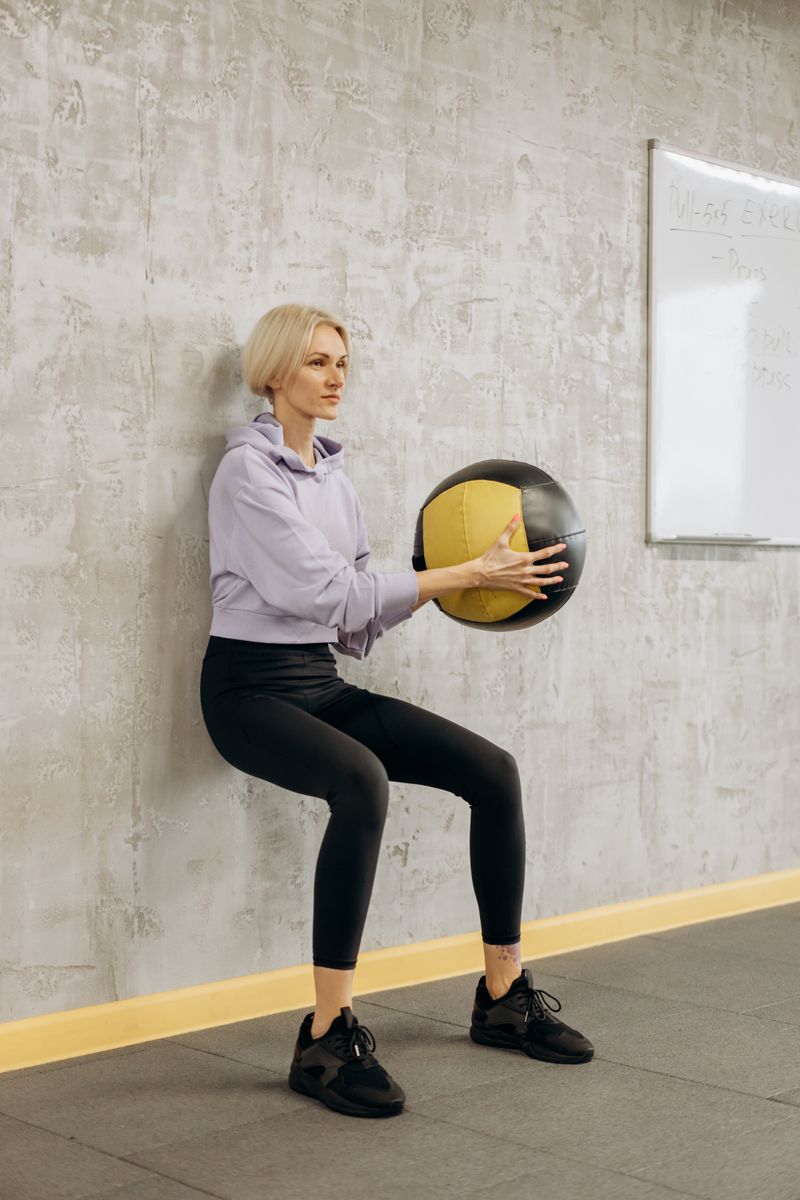
For squat jumps: Squat to calf raise. Descend into a squat, then rise to your toes instead of jumping. Increases time under tension and calf demand.
For high knees: High knee marches. Drive the knee up with intention but keep one foot on the floor at all times. Slower tempo but genuinely elevates heart rate.
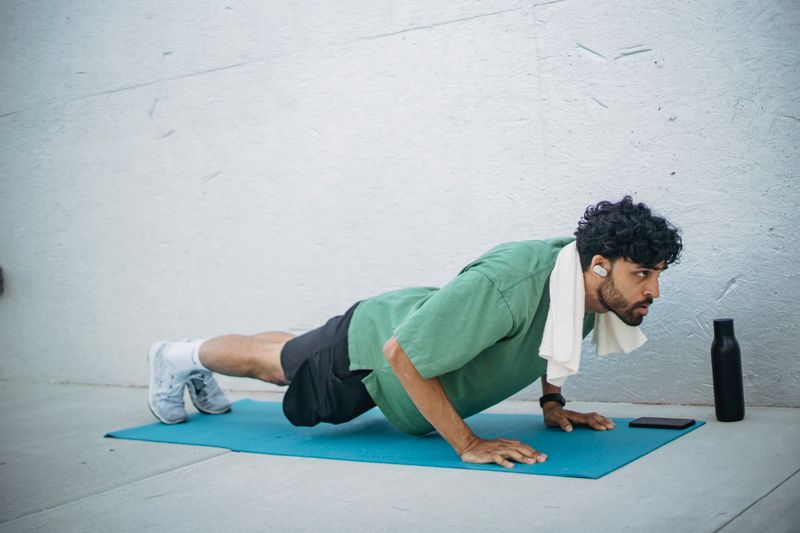
For burpees: Slow step-back burpees. Step one foot back, then the other (instead of jumping), do a push-up, step back forward, stand. A full-body movement that takes three times as long and makes zero noise.
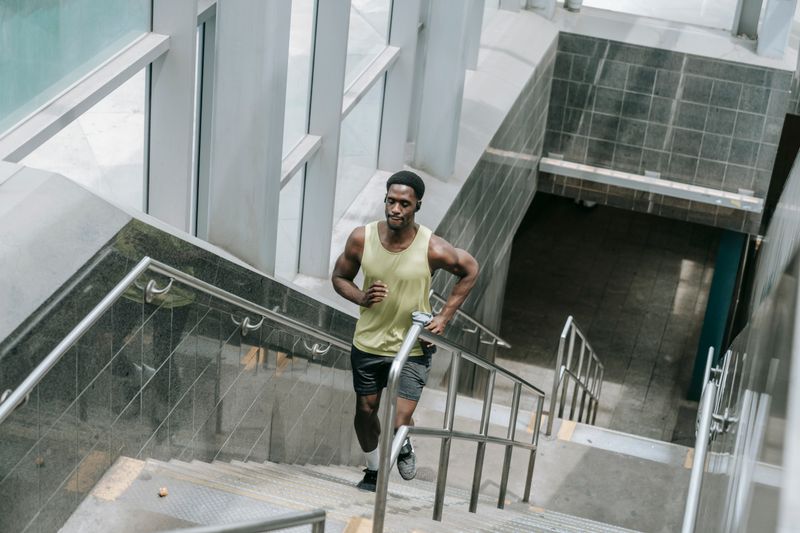
For cardiovascular training beyond floor work, staircase intervals are the most effective option for apartment dwellers with access to stairs. The staircase cardio guide covers the specific protocols.
The Equipment That Actually Helps in Small Spaces#
Most home gym equipment is poorly suited to small apartments. A treadmill takes up a quarter of a studio. A weight bench requires floor space you do not have.
Three items work well precisely because they do not take up space:
A resistance band set (around $15 to $30) hangs on a hook when not in use. It adds upper body pulling resistance that is otherwise difficult to achieve without a pull-up bar. The equipment guide for under $50 covers specific band options.
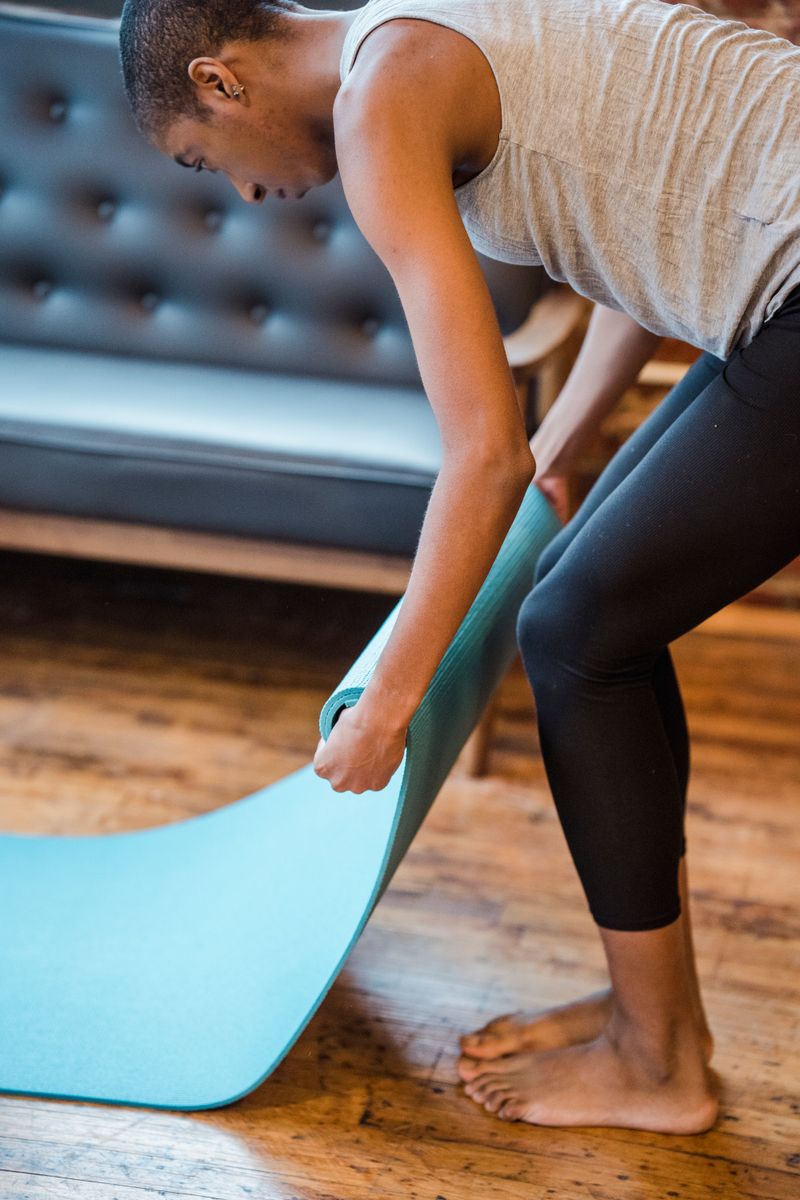
A yoga mat or puzzle tiles ($15 to $30) defines your training space, cushions your joints, and protects your floor. A standard mat folds against a wall and takes up inches of space.
A doorframe pull-up bar requires no permanent installation and stores in a doorway or closet. If upper body pulling is part of your program, this is the single most space-efficient tool available.
For a broader look at budget gear options, the best budget yoga mats guide and the 5 pieces of equipment under $50 article cover specific products.
A Complete Small-Apartment Routine#
This session fits in a 6-foot by 6-foot area, makes minimal noise, and provides a complete strength and conditioning stimulus.
Warm-up (5 minutes, standing)
- Leg swings: 10 per side
- Hip circles: 10 per side
- Arm circles: 10 per direction
- Thoracic rotation: 10 per side
Strength block (30 minutes)
Push-up (or wall push-up): 4 sets of 10 to 15 Rest 60 seconds
Bodyweight squat: 4 sets of 20 Rest 60 seconds
Reverse lunge: 3 sets of 12 per side Rest 60 seconds
Glute bridge or single-leg glute bridge: 3 sets of 15 Rest 60 seconds
Resistance band row (if bands available): 3 sets of 12 Rest 60 seconds
Plank: 3 holds of 45 seconds Rest 45 seconds
Cardio block (10 minutes)
Choose one:
- High knee march: 40 seconds on, 20 seconds rest, 8 rounds
- Step-back burpees: 30 seconds on, 30 seconds rest, 6 rounds
- Step jacks: 40 seconds on, 20 seconds rest, 8 rounds
Cool-down (5 minutes, floor)
- Hip flexor stretch: 60 seconds per side
- Seated hamstring stretch: 60 seconds per side
- Child's pose: 60 seconds
Total time: 50 minutes.
Scheduling Around Shared Walls#
If you share walls or floors, timing matters. Most noise complaints in apartments happen between 8 PM and 10 PM (evening training during quiet hours) and early mornings before 7 AM. Training at midday, mid-afternoon, or early evening eliminates most friction.
If you do need to train during sensitive hours, the strength block above makes almost no noise. The cardio block is adjustable: step jacks and high-knee marches are considerably quieter than anything involving jumps or drops.
The Bottom Line on Small Spaces#
A small apartment removes the convenience of sprawling into the floor space for a long dynamic session. It does not remove the ability to get a complete training stimulus. The substitutions above cover every major movement pattern within the footprint of a single yoga mat.
The constraints of small-space training are also filters: they eliminate genuinely inefficient exercise choices and force focus on the movements that produce the most benefit per square foot.
Do this today: Identify the largest 6-foot by 6-foot floor area in your apartment. If it requires moving furniture, move it once and see how the space feels for training. Five minutes of rearranging is not a barrier to a fifty-minute training session.