Slide discs are a legitimate piece of fitness equipment. They show up in physical therapy clinics, boutique studios, and online training programs at $15 to $25 a pair. They work by creating an unstable sliding surface under your hands or feet, which forces your muscles to work harder to control the movement.
You do not need to buy them.
Two small towels on a hardwood, tile, or laminate floor do the same thing. So does a pair of socks on a smooth surface, or two paper plates if your floors are smooth enough. The physics are identical: a surface that slides creates instability, instability increases muscle recruitment, increased muscle recruitment builds strength.
The only thing a $20 pair of slide discs adds is a slightly more consistent glide and a carrying bag.
Why Sliders Work#
The key mechanism is eccentric loading: the part of a movement where your muscles are lengthening under tension rather than contracting. Eccentric loading is where most strength and muscle development happens, and it's also the most demanding part of any exercise.
Standard bodyweight movements are concentric-dominant: you push up, you pull up, you stand up. Sliders flip the emphasis. In a slider hamstring curl, your hamstrings are under maximum load as they lengthen to extend your legs back to the floor: the hard part is the return, not the curl.
This matters because hamstring training is one of the most neglected areas in home workouts, and weak hamstrings are one of the most consistent predictors of knee and lower-back problems. A meta-analysis in the British Journal of Sports Medicine found that eccentric hamstring training reduced hamstring injury rates by around 50 percent. Sliders are one of the few ways to replicate that stimulus without a gym.
For the core, sliders create anti-extension and anti-rotation demands that static planks don't. Your abs aren't just holding a position; they're fighting against a moving surface to protect your spine.
What You Need#
Any smooth cloth on any smooth floor. Small dish towels, hand towels, socks (on hardwood), or paper plates all work. You need two: one for each hand or foot depending on the exercise.
Carpet doesn't work. The friction is too high and the cloth won't slide. If your home is carpeted, you can use furniture movers (the felt pads you put under chair legs) or smooth plastic Frisbees: both glide on carpet.
You need a floor and two small pieces of fabric. That's the entire equipment list.
The Movements#
Hamstring Curl#
Setup: Lie on your back, both heels on towels, legs straight. Hips on the floor. Movement: Drive your heels into the floor and curl them toward your hips, lifting your hips off the ground as your legs bend. Slowly extend your legs back to the start. Why it's hard: The return (extending your legs back to straight) is pure eccentric hamstring work. Control the slide. Don't let your legs snap back. Progression: Start with both legs. Work toward single-leg once you can do 3 × 10 with control.
Body Saw#
Setup: Forearm plank, both feet on towels. Movement: From a solid forearm plank, press through your forearms to slide your body backward (feet slide forward, body lengthens). Reverse to return to start. Why it's hard: Your core must maintain a rigid spine as your body extends further and further away from your base. This is an anti-extension drill: the same demand your abs face when you're trying not to arch your lower back during heavy work. Progression: Increase range of motion. More slide = harder.
Knee Tuck#
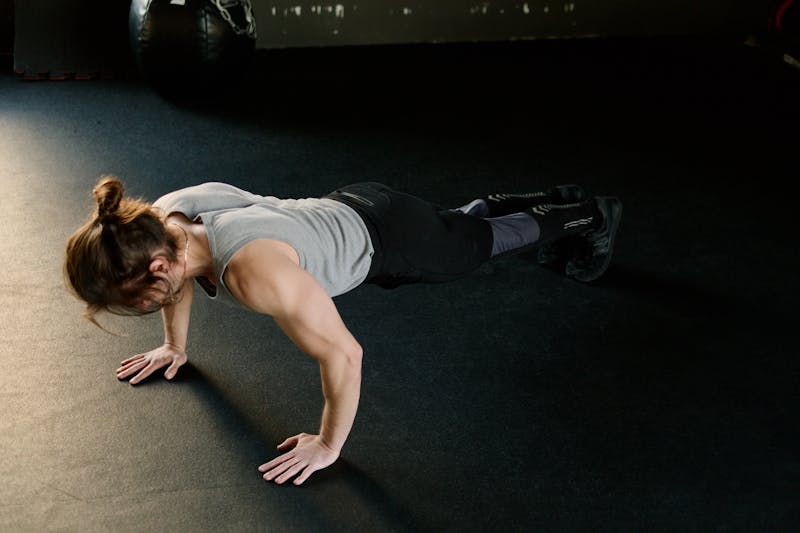
Setup: Push-up position, both feet on towels. Movement: From a straight-arm plank, draw your knees toward your chest, then extend back to plank. Why it works: Combines hip flexor strength with core stability. The instability of the sliding surface significantly increases the demand compared to a static mountain climber. Progression: Single-leg knee tuck (one foot on towel, one in the air).
Pike#
Setup: Push-up position, both feet on towels. Movement: Keeping your legs straight, push your hips up toward the ceiling, pulling your feet toward your hands. Return to plank. Why it's hard: Requires significant hamstring flexibility and core strength simultaneously. The goal is to get hips directly over shoulders with straight legs; most people will work toward this over several weeks. Progression: Straddle pike (feet wider than hip-width, slide out and up).
Lateral Lunge Slider#
Setup: Standing, one foot on a towel. Movement: Slide the towel foot out to one side, lowering into a lateral lunge on the standing leg. Drag the towel foot back to standing. Why it works: Loads the hip abductors and inner thigh in a range that standard squats don't reach. Also develops single-leg stability in the working leg. Progression: Increase depth, then pause at the bottom.
Reverse Lunge Slider#
Setup: Standing, one foot on a towel behind you. Movement: Slide the back foot rearward as you lower into a reverse lunge. Drive through the front heel to return to standing. Why it's better than a standard lunge: The slide requires your glutes and hamstrings to decelerate the movement on the way down rather than stepping back to a fixed position. More eccentric demand, more stability work. Progression: Deficit: elevate the front foot on a small step.
A Complete Session#
This session takes about 25 minutes. Do it two or three times a week on its own, or at the end of any strength session as finisher work.
Warm-up (5 minutes): Hip circles, leg swings, slow bodyweight squats × 10
Main work:
| Exercise | Sets | Reps / Duration | Rest |
|---|---|---|---|
| Hamstring curl | 3 | 10 | 60 sec |
| Body saw | 3 | 8–10 | 60 sec |
| Knee tuck | 3 | 10 | 60 sec |
| Pike | 3 | 8 | 60 sec |
| Reverse lunge slider | 3 | 8 each side | 60 sec |
Cooldown: Lying hamstring stretch, pigeon pose or figure-four, 90 seconds each side.
Progression Over Time#
The same principle from any other training applies here: do a little more than you did last session. That means more reps, a slower return phase, a greater range of motion, or moving to a single-leg variation.
A rough progression path:
- Weeks 1–2: Two-leg variations, smaller range of motion, stop 2 reps before failure
- Weeks 3–5: Full range of motion, longer eccentric phase (2–3 second return)
- Weeks 6+: Single-leg hamstring curls, straddle pike, deficit reverse lunges
None of these progressions require buying anything. The movement gets harder as you demand more control from the same two pieces of fabric.
One Thing to Watch#
Lower-back pain during the body saw or pike usually means your hips are dropping; your lumbar is going into extension instead of staying neutral. Fix: squeeze your glutes hard before you start the slide. If your hips drop mid-movement, reduce the range of motion until your core can hold the position.
Cramping in the hamstrings during the curl is common early on; it means your hamstrings are working harder than they're used to. Reduce reps, slow the movement, and it typically resolves within a week or two.
Do This Today#
Find two small towels. Put them on a smooth floor. Do one set of hamstring curls and one set of body saws. That's all. If your hamstrings are working harder than expected (they probably are), you've found a gap worth closing.
Two towels. No purchase required.