A hand towel on a hardwood or tile floor costs nothing and creates a training stimulus that most gym equipment does not. By removing traction from one end of a movement, the towel shifts the working muscle group into an eccentric-dominant position: your muscles work hardest while lengthening, not shortening.
This type of loading is associated with significant muscle damage and subsequent adaptation. It is also why movements like the Nordic curl and Romanian deadlift produce noticeable soreness after the first session. Towel exercises apply the same principle to bodyweight movements.
The Setup#
You need a smooth floor (hardwood, tile, or laminate) and either a hand towel, a small folded bath towel, or a pair of socks for your hands.
For foot-based exercises, a single folded towel under each foot works well. For hand-based exercises, a smooth cloth under each palm or just socks on your hands provides enough slip.
On carpet: socks on your feet work better than towels, since towels tend to bunch. Alternatively, a plastic bag under each foot on carpet provides enough reduction in friction.
Exercises That Work#
Hamstring Curl#
Lie on your back with knees bent and feet on the towels. Drive your hips into a bridge position, then slide your feet away from you until your legs are almost fully extended, then pull your heels back toward your hips. Keep the hips elevated throughout.
This is one of the most effective hamstring exercises available without equipment. The hamstrings work as both a hip extensor (holding the bridge) and a knee flexor (pulling the heels in), which is the dual function they perform during athletic movement. Research comparing hamstring exercises consistently places leg curl variations near the top for hamstring muscle activation.
Beginners: keep the range of motion short at first. Extend only partway out before pulling back in. Full extension is achievable after a few sessions of progressive range.
Towel Pike#
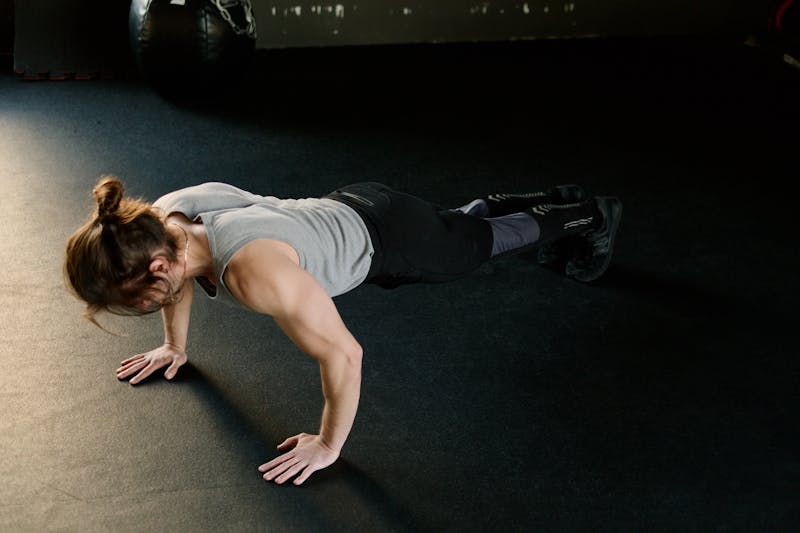
Start in a push-up position with both feet on towels. Keep your arms straight and slide your feet toward your hands, driving your hips up into a pike position. Pause, then slide back to the starting position.
The towel pike trains the core and hip flexors through a full range of motion. The abs work concentrically to pull the hips up and eccentrically to control the return. This movement builds toward the ab wheel rollout at a more accessible starting point.
Plank Body Saw#
Forearms on the floor, feet on towels. Shift your body backward (head toward the wall behind you) by pushing through the forearms, then pull back to the starting plank position. The movement is small: four to six inches is enough.
This is significantly harder than a standard plank because the core must resist spinal extension through the full range of movement rather than simply holding a static position. The long lever created by extending backward dramatically increases the demand.
Towel Mountain Climbers#
Standard mountain climber position, feet on towels. Instead of lifting and driving each knee, slide the feet alternately toward and away from the hands. The lack of lift removes some of the hip flexor demand and increases the core stability requirement throughout.
These are lower-impact than standard mountain climbers, which makes them useful for people in apartments or anyone avoiding high-impact work.
Lateral Lunge Slide#
Stand with one foot on a towel. Slide that foot out to the side as you lower into a side lunge, then pull it back to standing. The sliding leg stays extended throughout rather than bending, placing the demand almost entirely on the working leg’s glute and inner thigh.
Unlike a standard lateral lunge, the standing leg does all the work of lowering and raising your body while the sliding leg resists the slide. This creates a strong adductor and glute stimulus.
Push-Up to Extension#
Hands on towels, push-up position. Lower to the floor in a push-up, then instead of pressing up, slide your hands forward so your body extends along the floor (a sliding superman position). Pull the hands back to push-up position and repeat.
The forward extension phase creates a similar demand to the ab wheel rollout: the lats and core must resist the extension as your body lengthens. This is a meaningful step toward more advanced movements without requiring any equipment.
Single-Leg Towel RDL#
Stand on one leg with the other foot resting lightly on a towel behind you. Hinge forward at the hip while sliding the rear foot back, letting the rear leg extend. This is a towel-assisted single-leg Romanian deadlift that reduces balance demand while maintaining the hamstring stretch.
A Complete Towel Workout#
Warm-up (no towel, 5 minutes)
- Hip circles: 10 per side
- Bodyweight squat: 15 reps
- Leg swing: 10 per side
Working sets
Hamstring curl: 3 sets of 10 reps Rest 90 seconds
Towel pike: 3 sets of 8 reps Rest 90 seconds
Plank body saw: 3 sets of 10 reps Rest 60 seconds
Lateral lunge slide: 3 sets of 10 reps per side Rest 90 seconds
Towel mountain climbers: 3 sets of 20 (10 per side) Rest 60 seconds
Push-up to extension: 3 sets of 6 reps Rest 90 seconds
Total time: 35 to 40 minutes.
Why This Works When Standard Bodyweight Training Plateaus#
Standard bodyweight training eventually becomes limited by the fixed weight of the body. You can add reps, but past a certain point adding reps does not increase the challenge in the same way adding load does.
Towel exercises change the mechanics of the movement rather than adding load. The hamstring curl creates a bicep femoris demand that cannot be replicated with standard lunges or squats. The body saw creates spinal extension resistance that regular planks do not. These are new stimuli for muscles that may be undertrained despite regular bodyweight work.
The result is delayed-onset soreness after the first session and genuine adaptation over the following weeks, even in people who have been training consistently with standard methods.
Do this today: Put a towel under your feet while lying on your back and try three sets of hamstring curls. If you feel a strong hamstring contraction you do not recognize from regular workouts, you have found a gap in your training that this fills.