Free weights are one of the few fitness equipment categories where used is genuinely as good as new. A cast iron kettlebell doesn't wear out. A rubber-coated dumbbell doesn't have moving parts to fail. The iron is the same iron it was the day it left the factory.
This makes the used market for free weights unusually reliable, but it also means sellers sometimes overprice them, knowing buyers understand the durability. Here's how to find fair deals, what to inspect, and when to walk away.
Where to Find Used Free Weights#
Facebook Marketplace is the most efficient source in most areas. Search for "kettlebell," "dumbbells," or "weights" filtered by distance. Set a price alert if your area is thin on inventory.
Craigslist still has good free weight inventory, particularly for people offloading home gyms during moves. Prices are often lower than Marketplace because sellers have less visibility into current market rates.
Play It Again Sports is a used sporting goods franchise that buys and resells exercise equipment at set prices. Their pricing is often higher than private sellers but lower than new retail, and the equipment is inspected before resale. Good option if you want the used price without the hunting.
Estate sales and garage sales are the best source for underpriced weights. Sellers often don't know what free weights are worth and price them at a fraction of market value. Shows up early and look for weights lumped in with miscellaneous household items.
Gym closures and liquidations. Commercial gyms that close, downsize, or upgrade their equipment sell their inventory, often through liquidation companies or directly on Marketplace. Commercial-grade dumbbells (hex rubber, pro-style) are built to a higher standard than consumer products and make excellent used purchases.
What Fair Prices Look Like#
Free weights are priced by the pound. Understanding the price-per-pound market helps you identify deals and avoid overpaying.
Cast iron kettlebells:
- New: $1.50 to $2.50 per pound ($24 to $40 for a 16 kg / 35 lb bell)
- Used fair price: $0.75 to $1.25 per pound ($26 to $44 for a 35 lb bell)
- Used deal: Under $0.75 per pound
Rubber-coated hex dumbbells (individual):
- New: $1.50 to $2.00 per pound
- Used fair price: $0.75 to $1.00 per pound
- Used deal: Under $0.75 per pound
Standard iron plates (for barbell):
- New: $0.75 to $1.50 per pound
- Used fair price: $0.35 to $0.60 per pound
- Used deal: Under $0.35 per pound
Olympic bumper plates (rubber):
- New: $1.50 to $3.00 per pound
- Used fair price: $0.75 to $1.25 per pound
Anything priced significantly above new retail (which does happen, particularly post-pandemic when free weights became scarce) is worth passing on. The product doesn't appreciate.
Inspection: Kettlebells#
Cast iron (the standard)#
Cast iron kettlebells are the most durable option and have the fewest failure modes. Your inspection is straightforward.
Handle: Run your hand around the full circumference of the handle. It should be smooth without sharp edges, burrs, or pitting that would damage your palm during swings and cleans. Minor surface rust is cosmetic; it can be sanded off with medium-grit sandpaper in 10 minutes and doesn't affect function. Deep rust that pits the surface of the handle is a reason to pass or negotiate down.
Base: Inspect the flat base for cracks. A cracked base is a structural issue, particularly on a bell you're setting down repeatedly under load. Surface rust or dings are fine; actual cracks are not.
Weight accuracy: Most cast iron kettlebells are accurate to within 2 to 3 percent. If a bell is significantly lighter than marked (which you can verify on a luggage scale or bathroom scale), the seller may not know or may be misrepresenting it. Branded bells from recognized manufacturers (Rogue, Rep, Kettlebell Kings, Life Fitness) are almost always accurately marked. Unbranded bells from no-name manufacturers are less reliable.
Weight: Pick it up. The balance should feel centered. A bell that feels noticeably lopsided or that has a handle sitting off-center relative to the body may have a manufacturing defect.
Competition-style kettlebells (hollow steel)#
Competition bells are made from a single piece of steel and are identical in size across all weights; only the internal fill changes. They're more expensive than cast iron new and are often priced accordingly used.
Inspect the handle the same way you would a cast iron bell. Check that the handle color coding (if any) matches the stamped weight. Dents in the body are cosmetic; cracks are not.
Inspection: Dumbbells#
Hex rubber dumbbells#
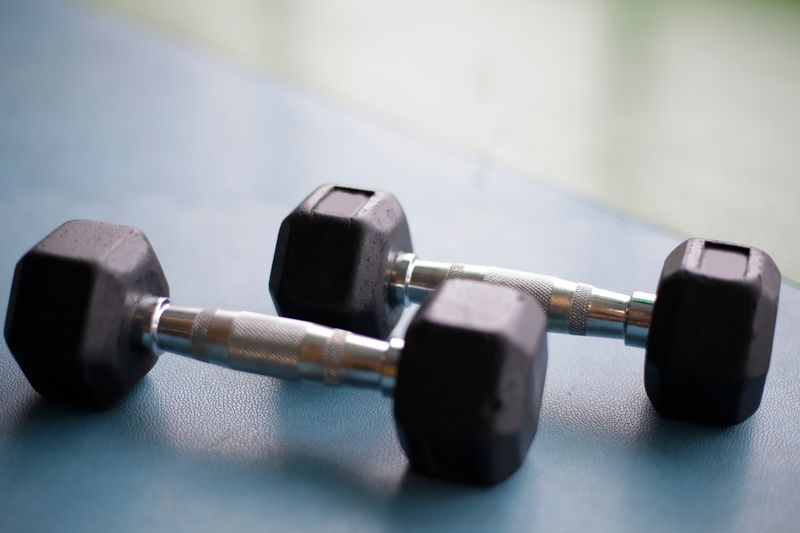
The most common home gym dumbbell. Six-sided rubber heads sit flat on the floor without rolling.
Rubber coating: Inspect each head for significant tears, chunks missing, or separating rubber. Minor surface cracks and scuffs are cosmetic. A head that's partially delaminated from the iron core will continue to separate and eventually creates a hazard when dropped.
Handle: The knurled (textured) grip area should be present and functional. A completely smooth handle makes the dumbbell genuinely harder to use and is a sign of significant wear. Check for cracks in the handle itself, rare on quality dumbbells but occasionally found on low-end models.
Weight symmetry: Hold the dumbbell at the center of the handle and see if it balances. If it tips noticeably to one side, one head may have lost rubber. This is a minor functional issue but worth knowing.
Adjustable plate-loaded dumbbells#
These have more components and more failure modes than fixed dumbbells.
Collars: The locking mechanism that keeps the plates on the handle. Spin each collar on and off several times. It should thread smoothly without wobbling or jamming. A stripped collar is a safety issue.
Handle: Check for bending at the ends, which indicates the handle has been dropped heavily or used with more weight than it was rated for. A bent dumbbell handle will torque in your hand during use.
Plates: Inspect the same way you would any iron plate: cracks, significant rust, accurate weight markings.
Selectorized/dial-select dumbbells (Bowflex, PowerBlock)#
These have the most moving parts and the most failure modes. Inspect carefully.
Mechanism: Select each weight setting and pick the dumbbell up. Shake it slightly. The plates that are supposed to stay in the cradle should stay put; the selected plates should lock firmly. Any rattle or drop from the mechanism indicates worn internal components.
Dials and pins: Rotate the dial through every setting and confirm the weight changes smoothly. A sticky or skipping dial often indicates a cracked weight selector or bent guide rail.
Cradle: Inspect the cradle (the storage tray) for cracks, which are common in PowerBlock and Bowflex units that have been dropped. A cracked cradle is cosmetic if the locking mechanism still works, but it will continue to fail and eventually become a problem.
What to Skip Entirely#
Unbranded cast iron from unknown sources at any price. The weight accuracy is unreliable, the finish quality is poor, and the handles are often rough enough to damage your hands. There's enough used name-brand inventory that this category isn't necessary.
Any dumbbell with a split or fully delaminated rubber head. The repair isn't practical and the hazard is real.
Selectorized dumbbells with a broken or skipping mechanism at any price. Replacement parts are expensive and often unavailable. The mechanism either works or it doesn't.
Anything the seller won't let you physically handle and inspect before buying. This applies to all used equipment but especially to free weights listed only in photos. Sellers who won't let you pick up and inspect a kettlebell usually have a reason.
The Math#
A 35 lb kettlebell bought new costs roughly $35 to $65 depending on brand. Found used in good condition at $0.90/lb, the same bell costs about $32. The savings are modest on a single piece.
The math improves on volume. Outfitting a home gym with 200 lbs of dumbbells new costs $300 to $400. Used at $0.75/lb, the same weight costs $150. That's a meaningful difference that compounds if you're building a complete setup over time.
If the used market is thin in your area, here are the new options worth buying at fair prices:
The budget cast-iron option. Slightly rougher finish than premium brands but functionally identical for most training. Accurate weight markings. Start here if you're buying new.
Check price on AmazonRubber-coated hex heads, solid steel handles with knurling. The most reliable budget option for fixed dumbbells when you can't find used. Buy the specific weights you need rather than a full set.
Check price on AmazonDo this today: Search Facebook Marketplace for kettlebells within 25 miles. Filter by price to see what's available under $1/lb. Even if you're not buying today, understanding the local market helps you recognize a deal when one appears.