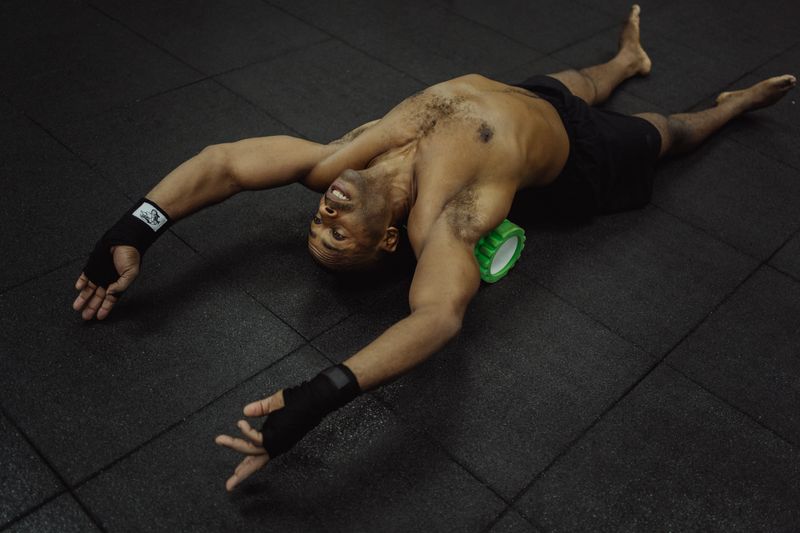
Recovery has become its own industry. Walk into any sporting goods store and you'll find massage guns with multiple attachments and companion apps, vibrating foam rollers, compression boots that retail for more than most people's rent, and infrared saunas small enough to fold up and ship to your door. The pitch is always the same: recover faster, perform better, feel less sore.
The research tells a more boring story — and the boring story is actually useful.
The Truth About Percussive Therapy Tools#
Theragun, Hypervolt, and their competitors have built a genuine category. Massage guns use rapid percussive pulses — typically 1,750 to 2,400 RPM — to deliver deep tissue stimulation that's difficult to replicate manually. The premium models run $200–400 and come with multiple attachment heads, adjustable speed settings, and in some cases app integration for guided recovery protocols.
A 2020 study in the Journal of Sports Science and Medicine found that percussive therapy does reduce delayed onset muscle soreness and improve range of motion. The effect is real. The question is whether it's meaningfully better than simpler alternatives at a fraction of the cost.
What it gets right:
- Genuinely easier to use on hard-to-reach areas like the upper back and glutes than a foam roller
- Faster to apply — 60 seconds per muscle group with a gun versus several minutes of rolling
- The percussive effect reaches deeper tissue than surface foam rolling for some users
- Useful for people with mobility limitations that make floor-based foam rolling difficult
Where it falls short:
- Research comparing massage guns to foam rolling shows comparable outcomes, not significantly superior ones — you're paying a large premium for a modest convenience improvement
- $200–400 is a meaningful purchase for a tool that isn't doing substantially more than a $12 cylinder
- The companion apps and multiple attachments add complexity that most users don't need
- Battery-dependent; not the tool you want running dead 10 minutes before a workout
The Truth About Budget Recovery Tools#
A basic foam roller costs $10–15. A 2015 meta-analysis in the Journal of Athletic Training found that foam rolling after exercise meaningfully reduces delayed onset muscle soreness and improves range of motion in the days following training. The physics are straightforward: you're applying sustained pressure to soft tissue to improve blood flow and reduce tightness. A $12 high-density cylinder does this as effectively as a $150 vibrating version.
Add a lacrosse ball ($2–4) for trigger points — the specific knots in your upper back, glutes, and the bottoms of your feet that a roller can't reach precisely. Firm enough for real pressure, cheap enough that losing one isn't a problem. Buy two.
A resistance band or dish towel handles assisted stretching. Flexibility work after training improves range of motion over time and reduces the chronic tightness that leads to injury. No specialized equipment required.
What it gets right:
- Foam rolling has consistent research support; this isn't a wellness trend, it's a functional tool
- The total cost of a foam roller plus lacrosse balls plus a band: under $30
- Works for the full-body recovery protocol — rolling, trigger point work, and assisted stretching
- No batteries, no apps, no maintenance
Where it falls short:
- Harder to reach the upper back and thoracic spine effectively without some practice
- Takes longer per muscle group than a massage gun
- Floor-based rolling is inconvenient for some people, particularly those with mobility or pain limitations
- The soft, squishy foam rollers that compress under bodyweight don't actually do much — you need a high-density roller, not the cheapest available
Where It Lands#
For the vast majority of people training 3–5 days a week: a $12 high-density foam roller and a $4 lacrosse ball. That's the full recovery tool kit. The research supports it, the cost is negligible, and it works.
Standard high-density cylinder. Stays firm after repeated use. Get this one, not the soft version.
Check price on AmazonFor trigger points that a roller can't reach precisely. Firm enough to apply real pressure. Buy two.
Check price on AmazonThe one case for a massage gun: if you have significant mobility limitations that make floor rolling difficult, or if you're doing two-a-day training with serious accumulated fatigue and time-constrained recovery windows. At that point, the convenience argument has some merit.
For everyone else, the expensive device is solving a problem that a $12 tool already handles. Sleep eight hours. Get enough protein. Roll out for 10 minutes. That protocol beats most of what the recovery industry is selling you, and it costs almost nothing.